

21-Day Capital Doubling or Total Wealth Eradication? Understanding the Core Mechanics of Ponzi Schemes
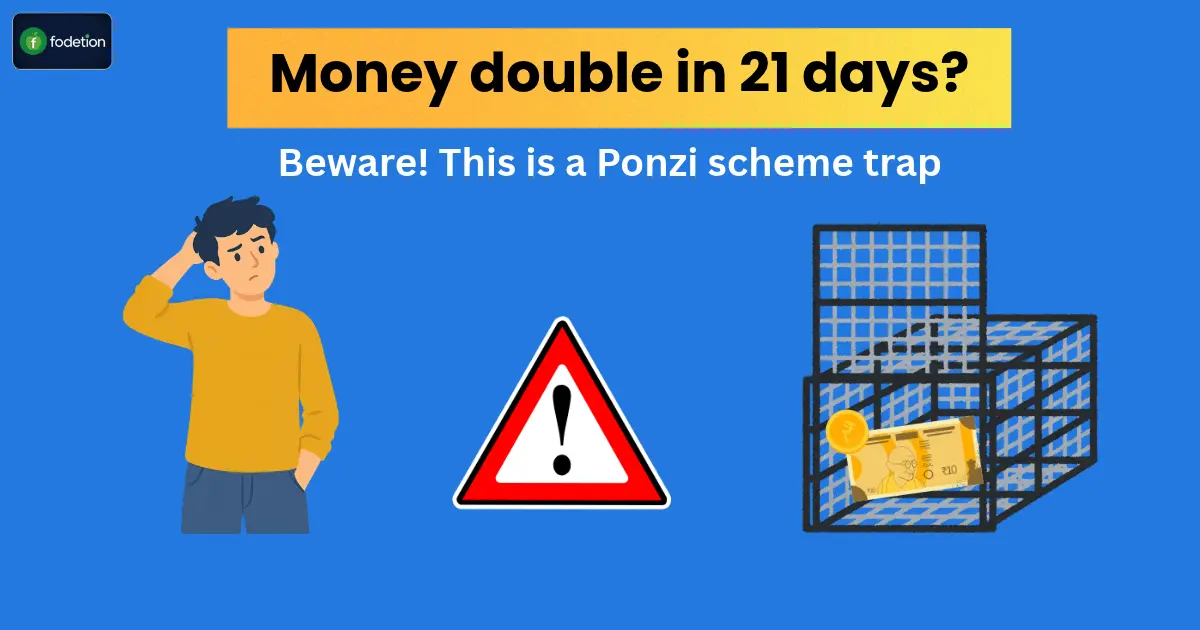
If you closely analyze the illustrative banner above, the individual depicted mirrors the profile of an average retail investor. Confronted by a flashing display guaranteeing an exponential "21-Day Capital Doubling," he stands between a critical systemic warning sign (⚠️) and an engineered containment cage baited with high-denomination currency tranches of ₹200 and ₹500 bank notes.
The participant exhibits severe cognitive dissonance, pondering: "The value proposition appears exceptionally lucrative. Allocating a principal of ₹50,000 would theoretically yield ₹100,000 in short-term liquidity within a 21-day horizon, effectively mitigating my immediate financial liabilities. However, does this structural setup conceal a fraudulent capital trap? Why is the containment unit actively baited with liquid currency instead of remaining vacant?"
If your personal portfolio management decisions have ever been tempted by similar high-yield assertions across digital interfaces, unregulated communication channels, or algorithmic mobile applications, this exhaustive breakdown is critical for your wealth protection. The individual is standing at the threshold of a terminal capital rotation trap universally classified as a 'Ponzi Scheme.' Let us deconstruct the structural mechanics of this economic containment architecture and analyze exactly how this trap operates.
A Ponzi scheme is not a legitimate wealth-generating business model; rather, it is a fraudulent capital rotation network where returns to historical investors are paid using the principal injected by secondary participants, instead of authentic operational revenues. While transparent corporate entities rely on physical production, asset creation, or verified service delivery for market sustainability, these fraudulent platforms exploit behavioral heuristics and the psychological drive for rapid capital appreciation. Within corporate governance and financial markets, this architectural flaw is recognized as a terminal investment hazard that systematically erodes retail capital. It functions as an unsustainable economic cycle that remains operational exclusively as long as the velocity of incoming capital outpaces exit liabilities.
Technical Synonyms & Consumer Classifications
Within the global and Indian regulatory landscape, retail investors, law enforcement agencies, and wealth managers classify and search for these fraudulent structures under several authenticated financial terms:
- High-Yield Investment Programs (HYIP)
- Pyramid Distribution Networks
- Unregulated Collective Investment Schemes / Unregistered Chit Funds
- Money Circulation and Capital Rotation Frauds
- Guaranteed Fixed-Return Arbitrage Scams
Historical Origins and the Anglo-Indian Regulatory Framework
The nomenclature of this financial fraud traces back to Charles Ponzi, an immigrant clerk who engineered a massive arbitrage fraud in North America during the early 1920s utilizing International Reply Coupons. Ponzi promised extraordinary returns to early investors within a compressed timeframe. Instead of deploying the accumulated principal into an active commercial trade, he distributed the capital inflows of new entrants to liquidate the maturity liabilities of older participants. When the required velocity of secondary recruitment slowed down, the structural mismatch triggered an immediate liquidity crunch, resulting in systemic defaults and absolute wealth destruction for participants.
In the Indian financial ecosystem, statutory authorities have enacted stringent legislative frameworks to suppress unregulated deposit pools. The primary legislative shield is The Banning of Unregulated Deposit Schemes Act (BUDS Act, 2019). Furthermore, apex financial watchdogs including the Securities and Exchange Board of India (SEBI), the Reserve Bank of India (RBI), and specialized Economic Offences Wings (EOW) of law enforcement maintain rigorous regulatory oversight over capital accumulation. Under prevailing Indian corporate jurisprudence, operating, promoting, or marketing any investment program that guarantees fixed or exponentially high returns without a registered, revenue-generating underlying asset is classified as a severe, non-bailable criminal offense.
Key Takeaways
To execute effective risk assessment and identify fraudulent capital pools, wealth managers emphasize these core indicators:
- Fictional Yield Generation: Distributed payouts do not originate from corporate net profits or underlying cash flows, but directly from the liquid principal of subsequent entrants.
- Absence of Tangible Assets: The entity possesses zero underlying physical infrastructure, plant machinery, corporate real estate, or proprietary technological intellectual property.
- Artificial Social Proof: Promoters deliberately maintain flawless initial disbursement cycles to construct artificial creditworthiness, transforming early participants into organic brand advocates who inadvertently recruit their social networks.
- Abrupt Liquidity Implosion: The moment the volume of incoming primary deposits drops below the operational exit curve, the masterminds halt withdrawals and execute terminal asset siphoning.
- Regulatory Isolation: These platforms deliberately operate outside the statutory boundaries established by scheduled commercial banking frameworks and capital market watchdogs like SEBI.
- Deficit of Transparency: The operational books of accounts, statutory cash flow statements, and independent third-party audit reports are entirely inaccessible to the public.
- Recruitment-Driven Revenue: The organizational architecture prioritizes participant acquisition metrics over commercial transactions or service distribution.
Three Practical Indian Case Studies to Demystify Capital Rotation
To strip away complex legal jargon, let us analyze three distinct real-world operational models frequently deployed to target retail portfolios:
1. The Proliferation of Digital Assets and High-Yield Mobile Applications
Modern fraudulent syndicates launch sophisticated digital portals or mobile interfaces claiming proprietary exposure to offshore tech setups, green energy projects, or advanced cryptographic algorithms.
- The Modus Operandi: Retail participants are instructed to deposit a baseline principal (e.g., ₹10,000) with the guarantee of receiving an unfluctuating daily passive yield (e.g., ₹500) credited to their digital wallets, reinforced by percentage-based referral bonuses for secondary user onboarding.
- The Structural Failure: The application dashboard projects complex data visualizations and artificial ledger growth. In reality, no commercial operations or market trades occur. The daily payouts distributed to historical accounts are simply chunks of liquid principal transferred from secondary users who joined later.
- Strategic Lesson: Aesthetic software design, high digital engagement metrics, and sustained initial payout cycles do not validate the presence of a legally compliant corporate business model.
2. Fractional Agricultural Pledges and Timber Cultivation Scams
Promoters approach suburban and rural saving pools, claiming to manage massive corporate agro-forestry models focused on high-demand premium commodities, such as teakwood, sandalwood, or specialized livestock cultivation.
- The Modus Operandi: Promoters solicit capital under the pretext of land-parcel booking, guaranteeing that natural agricultural compounding will safely double or triple the invested capital over a fixed multi-year horizon without correlation to market risks.
- The Structural Failure: The operators secure minimal physical land assets to display as visual tokens for visiting delegations, while collecting capital that vastly exceeds the real valuation of the property. The returns distributed to mature tranches do not originate from harvest yields, but from the capital deposits of subsequent agrarian investors.
- Strategic Lesson: Agricultural and real estate investments are bound by natural production timelines and macroeconomic cycles; any physical asset model claiming fixed, exponential returns completely insulated from systemic risk is structurally fraudulent.
3. Multi-Level Travel Accommodations and Fictional Subscription Packages
Fraudulent networks organize high-end corporate seminars at premium venues, inviting families under the guise of promotional rewards or lucky-draw allocations.
- The Modus Operandi: Consumers are persuaded to purchase long-term premium holiday memberships (e.g., ₹50,000 upfront) promising annual luxury hotel access. Simultaneously, the contract dictates that if the subscriber recruits two additional members, their initial subscription overhead is fully refunded, transitioning them into a permanent royalty tier.
- The Structural Failure: The entity owns no real property rights or verified tie-ups with hospitality providers. When a member attempts to liquidate their holiday credits, the platform invokes blackout dates, seasonal non-availability, or structural system upgrades. The primary revenue driver is simply the cash flow generated from continuous member enrollment.
- Strategic Lesson: When an organization prioritizes recruitment velocity over product or service consumption, the architecture is fundamentally a disguised capital rotation system.
The Five Operational Phases of a Ponzi Network
A Ponzi scheme operates through a highly engineered lifecycle consisting of five distinct structural steps:
Phase 1: Statutory Mimicry and Structural Setup
The promoters establish a shell corporate entity, secure rudimentary commercial registrations (like shop licenses or basic tax numbers), and deploy professional digital setups. They author elaborate structural guidelines that mimic authentic finance terminology to deliberately bypass early retail skepticism.
Phase 2: Targeted Attraction and Early Client Onboarding
The network initially focuses on demographic groups with immediate capital liquidity but limited financial asset exposure, such as retired corporate professionals or individuals with accumulated family savings. They introduce fixed yield metrics that significantly outperform prevailing banking interest rates.
Phase 3: Payout Initialization and 'FOMO' Induction
The network maintains absolute fidelity in distributing early payouts. When these initial yields hit bank accounts, it removes the participants' risk aversion. The participants organically promote the scheme to their close networks, creating an artificial environment of FOMO (Fear of Missing Out) within the local community.
Phase 4: Velocity Acceleration and Hyper-Expansion
Capital inflows enter a phase of vertical growth. Driven by social proof, retail investors execute suboptimal allocation decisions—liquidating land parcels, pledging family gold ornaments, or securing high-interest personal banking loans to allocate capital into the platform. The promoter's liquid cash reserves hit their historic peak during this phase.
Phase 5: Liquidity Choking and Terminal Collapse
As the historical participant base expands, the cumulative liability to service older dividends increases exponentially. The moment fresh capital accumulation drops below the required payout velocity, a system-wide cash crunch occurs. The platform restricts capital exits under the guise of regulatory audits or technological server overhauls before the shadow promoters go dark, leaving the retail base completely exposed to a 100% loss.
Ownership Matrix and Corporate Governance Realities
Unlike publicly traded corporate entities characterized by transparent shareholding registries and traceable ownership structures, a Ponzi scheme relies on complete distortion of corporate governance:
- Shadow Promoters: The true operational masterminds never occupy traceable board positions or hold official equity voting power. They utilize vulnerable front-facing nominees to shield themselves from future white-collar criminal prosecutions.
- Absence of Institutional Capital: Scheduled commercial banks, qualified venture capital funds, and registered institutional asset managers never provide debt or equity financing to these setups, as they fail standardized institutional due diligence protocols.
- Agent-Centric Distribution: The marketing network relies on an aggressive multi-tier agent commissions matrix. These independent micro-promoters operate without ownership equity; they are incentivized via a variable percentage of the liquid capital brought in by their direct recruits.
- Illiquid Capital Lock-Ins: The contract structures enforce rigorous, long-term capital lock-in parameters or confiscatory early exit penalties. This is strategically executed to prevent premature cash drainage and secure structural stability for the internal rotation pool.
Macro-Economic Benefits of Risk Exposure Mapping
While these schemes are inherently destructive, deep analysis of their structural mechanics provides essential strategic advantages for the broader wealth management ecosystem:
- Optimization of Regulatory Early Warning Systems: Deconstructing the failure loops of unregulated deposit schemes enables apex regulators to upgrade their predictive surveillance frameworks to detect shadow financial operations early.
- Fortification of Statutory Safeguards: Legislative actions following the closure of fraudulent networks close systemic loopholes in banking laws and retail capital protection rules.
- Capital Reallocation to Compliant Portfolios: Exposing the structural invalidity of fictional yields drives retail investors to reallocate their capital toward authenticated, asset-backed wealth instruments.
- Evolution of Financial Literacy: Demystifying unearned capital appreciation establishes a disciplined market culture that values realistic compounding metrics over artificial wealth traps.
Taxation Realities and Statutory Forfeiture Systems
If an investor presumes that participation in unregulated deposit structures offers an avenue for tax-sheltered wealth generation or deductible speculative positions, they must review prevailing tax codes:- Non-Deductibility of Sunk Capital: If an unregistered platform defaults or vanishes, the Income Tax Department does not recognize the lost principal as a valid business loss or short-term capital loss. The individual receives zero tax relief or write-offs for the financial mishap.
- Statutory Asset Attachment under the BUDS Act: The prevailing legal framework empowers enforcement directorates and special courts to execute immediate ad-interim attachment and ultimate forfeiture of all immovable and movable assets held by the operator, promoters, and principal agents to recover public deposits.
- Defacto Illegality of Unregistered Pools: Any collective investment structure operating without an explicit, active registration certificate issued by SEBI or the RBI is classified as a statutory financial hazard by default.
- Taxation of Fractional Commission Inflows: Agents accumulating high commission percentages from these platforms face severe tax consequences. Regulatory audits classify these inflows as unexplained cash credits, invoking maximum marginal tax rates along with severe criminal penalties for tax evasion.
Asymmetric Risk Profiles and Structural Limitations
- Absolute Capital Eradication: While institutional equity portfolios face standard market volatility where asset valuations fluctuate, a Ponzi scheme implosion results in a permanent 100% capital wipeout.
- Entrapment in the Sunk Cost Fallacy: When a platform freezes capital distributions, operators often demand secondary maintenance fees under the pretext of unlocking accounts. Investors frequently succumb to the Sunk Cost Fallacy, injecting additional liquidity to protect historical outlays, which amplifies their total financial damage.
- Criminal Liability Exposure: An investor who actively recruits secondary participants to claim high referral commissions changes their legal status from an innocent victim to a functional accomplice, exposing themselves to direct prosecution under economic defense laws.
- Social Capital Destruction: These schemes completely disrupt mutual trust within communities and extended family units, as recruitment tactics heavily exploit pre-existing personal relationships.
Balance Sheet Disruption: Legitimate Corporate vs. Ponzi Framework
An evaluation of the foundational accounting equation (Assets = Liabilities + Shareholders' Equity) reveals the absolute structural divergence between real economic models and money rotation mechanisms:
Legitimate Corporate Architecture (Asset-Backed Growth)
When a compliant corporation raises capital via debt or equity, the funds flow directly into the asset side of the balance sheet to acquire productive fixed assets (such as manufacturing plants, core technology code, or operational real estate). These assets generate genuine cash flow, which services operational liabilities and expands equity value.
Investor Capital-----Productive Fixed Assets (Infrastructure/Code-----Net Revenue Generation-----Sustainable Shareholder Yield
Ponzi Fictional Architecture (Debt-Driven Inflation)
A Ponzi setup records incoming investor capital as cash on the asset side, balanced by an immediate liability (the contractual promise of high fixed returns). However, there is a total deficit of productive underlying assets. No operational engine exists; the platform merely utilizes cash from new liabilities to satisfy historical debt obligations until structural bankruptcy occurs.
Secondary Capital Inflow-----Liquidation of Historical Liability tranches-----( Zero Productive Asset Accumulation)
Digital Intermediaries and the 'Finfluencer' Media Trap
In the modern digital economy, financial fraud has evolved to deploy sophisticated online marketing tactics. Syndicates leverage digital platforms and social media micro-influencers (Finfluencers) to project an image of secure luxury asset creation. These promoters utilize lifestyle aesthetics—such as luxury cars and high-end travel logs—to exploit retail behavioral biases.
They provide unverified digital referral links, encouraging users to join private communication channels (e.g., closed Telegram or WhatsApp groups) where artificial profit screenshots are systematically deployed. When regulatory enforcement strikes, these digital channels are deleted instantaneously, leaving the retail investor completely isolated without legal recourse or trace.
Comparative Matrix: Systemic Structural Differences
The following table provides a scannable overview of the core operational parameters separating legitimate capital channels from fraudulent rotation structures:
| Operational Parameter | Sovereign / Scheduled Banking Instruments | Public Equities / Regulated Mutual Funds | Unregulated Capital Rotation Schemes (Ponzi) |
|---|---|---|---|
| Yield Profile | Moderate, fixed, and highly secure | Variable, market-linked, with macro risk adjustments | Exceptionally high, fixed, and entirely decoupling from macro realities |
| Capital Deployment Zone | Sovereign infrastructure and verified commercial debt pools | Corporate equity asset deployment and working capital | Non-productive internal allocation; immediate payout to historic tranches |
| Systemic Risk Exposure | 0% default probability within statutory limits | Moderate to high, depending on industrial market volatility | 100% absolute capital loss probability upon system saturation |
| Regulatory Guardrails | Direct RBI protection and banking channel oversight | Comprehensive SEBI compliance, disclosure rules, and quarterly audits | Zero compliance; completely outside statutory frameworks |
| Information Transparency | High; public availability of standardized balance sheets | Complete; audited financial disclosures published quarterly | Absolute deficit; opaque operational metrics and closed source ledgers |
Pre-Investment Portfolio Action Checklist
Before allocating capital into any high-yield investment vehicle, wealth managers dictate the execution of this strict due diligence checklist:
- Verify Regulatory Credentials: Cross-reference the platform’s corporate registration details directly on the official verification portals of SEBI, RBI, or the Ministry of Corporate Affairs (MCA). Simple tax numbers or local business licenses are not valid licenses to aggregate public deposits.
- Deconstruct the Revenue Engine: Mandate a clear, written explanation detailing the exact operational mechanisms that generate the promised yields. If the asset conversion cycle is opaque or illogical, reject the position.
- Evaluate Capital Liquidity Rules: Scrutinize the contract's fine print for hidden lock-in periods, arbitrary exit barriers, or confiscatory early withdrawal penalties.
- Perform Management Background Checks: Conduct exhaustive checks on the corporate history of the principal officers and promoters to ensure zero past involvements with shell companies or economic offenses.
- Validate Third-Party Audits: Confirm that the entity's financial statements are audited by independent, certified, and traceable chartered accountancy firms rather than unverified internal committees.
Wealth Manager’s Strategic Opinion
"The foundational axiom of institutional asset management remains absolute: there is zero room for structural miracles in capital compounding. Sustainable wealth accumulation is fundamentally linked to macroeconomic output, technological efficiency, and real corporate asset performance. Any investment program that promises fixed, high-velocity returns while claiming a complete elimination of market risk is structurally engineered to seize your principal. High-net-worth protection requires absolute emotional discipline to look past social media hype and reject non-regulated pools. Prioritize capital preservation within verified, statutory frameworks over the illusion of unearned high yields."
Smart FAQs: Advanced Professional Breakdown
Q1: Why do Ponzi schemes maintain flawless dividend distribution cycles in their initial phases if they lack real revenue?
Ans: Initial payout execution is a calculated behavioral engineering tactic. By utilizing the liquid principal brought in by early secondary entrants to pay historical tranches on time, the promoters neutralize risk aversion and construct artificial social proof. This triggers mass participant trust, prompting investors to scale up their outlays and naturally market the platform to their networks.
Q2: Can a legally compliant, operating corporate entity transition into a Ponzi scheme over time?
Ans: Yes. If an established corporation suffers severe business model failure, operational losses, or extreme debt accumulation, the management may choose to obscure insolvency rather than declaring bankruptcy. If they begin raising fresh public capital under false pretenses—using secondary deposits to service historical liabilities and interest payments instead of rebuilding the core business—the corporation transforms into a functional Ponzi scheme.
Q3: What immediate legal and operational steps should an individual execute if they identify a Ponzi scheme inside their active portfolio?
Ans: The investor must immediately halt all further capital allocations, decline any demands for account maintenance fees, and attempt a complete liquidation of the principal balance. If the platform blocks capital exits, the individual must immediately file a comprehensive written complaint with the local Economic Offences Wing (EOW) and lodge a formal alert on the National Cyber Crime Reporting Portal (cybercrime.gov.in) to establish their status as an affected party.
Q4: What is the defining structural line separating multi-level product marketing (MLM) from a fraudulent Ponzi network?
Ans: The distinction lies in the primary driver of the cash flow matrix. In a legitimate MLM structure, revenues are derived from the end-user consumption of real, commercially viable goods or services, featuring clear market pricing and return policies. In a Ponzi network, either no physical product exists or it functions as a worthless visual token; the entire revenue engine depends on aggregating registration entries and rotating member capital.
Q5: Should short-term algorithmic trading tips distributed via digital groups be integrated into a retail investment strategy?
Ans: Absolutely not. Unregulated digital groups promising high-velocity trading yields are almost entirely fraudulent setups. They exploit behavioral vulnerabilities by displaying manipulated trading ledgers to collect primary deposits. Once a significant pool is accumulated, they execute total digital blockages. Portfolios should rely exclusively on authorized investment advisers holding valid regulatory credentials.
November 4, 2026 10:37 PM
SHARE BLOG