

The Unique Math of Investing: How Your Money Travels From a 'Farm' to a 'Mall'
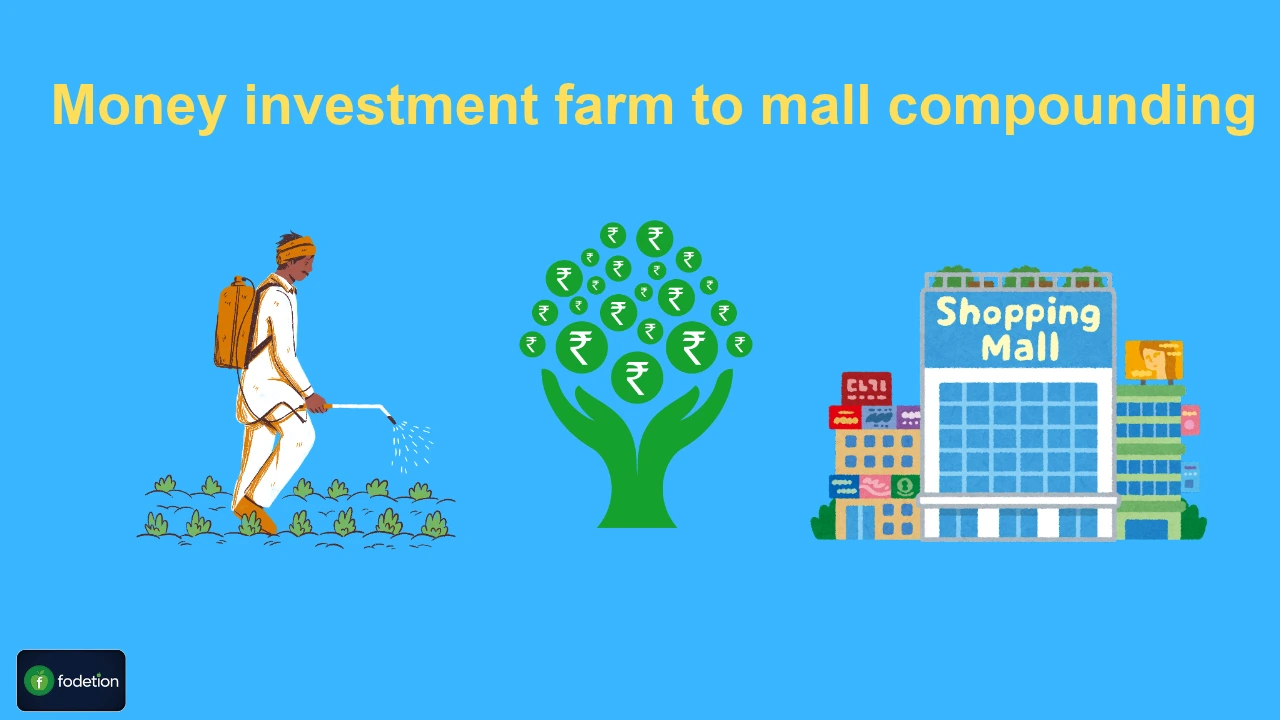
The Unique Math of Investing: How Your Money Travels from a 'Farm' to a 'Mall' to Become Premium!
Have you ever wondered why an apple, purchased from a farmer in the orchards (farms) of Kashmir or Himachal for just ₹20 or ₹30 per kg, costs ₹250 to ₹300 per kg by the time it reaches a luxurious supermarket in a big city mall?
The taste of the apple is the same, and its vitamins are identical. So, how did its price skyrocket 10 times?
The simple answer is— Value Addition, Right Positioning, and Right Timing.
As the product moves from the farm to the mandi (wholesale market), wholesalers, retailers, and finally to a luxury mall, its economic value and brand equity change at every stage. This exact unshakeable rule applies to your Time and Money. In the world of personal finance and the stock market, where, when, and how you invest your capital dictates whether you will build substantial wealth or struggle financially in the future.
Let’s dive deep into the 4 biggest rules of finance using this practical farmer's analogy to completely transform your financial life.
The Farm = Your Bank Savings Account and Cash (Underutilized Asset)
When crops or fruits are on the farm, they are in their purest, rawest form. They possess infinite potential to feed thousands, but their immediate economic value at that place and time is the lowest. If a farmer does not move the produce out of the farm on time, it will rot right there.
The Financial & Stock Market Connection:
Keeping your hard-earned money idle in a bank savings account, locked in a home safe, or hoarding it as hard cash is exactly like leaving your crops to rot on the "farm."
- The Termite of Inflation (Inflation Risk): Today, the average inflation rate hovers around 5% to 6%, while a typical bank savings account yields only 3% to 3.5% interest. This simply means your money is losing its real value every year instead of growing.
- Loss of Purchasing Power: If you leave ₹1,00,000 in your savings account, it might look like ₹1,03,000 on paper next year, but its actual purchasing power will have shrunk. Your money is like that harvest on the farm being slowly eaten away by the termites of inflation.
Mandi & Wholesaler = Mutual Funds and Index Funds (The Power of Diversification)
When a farmer brings the harvest to the mandi, wholesalers take over. Here, the produce is sorted, bad stock is discarded, and quality grading takes place. A wholesaler never takes a risk on a single crop; they buy wheat, pulses, and rice from various farmers to balance their risk. The moment the crop enters the mandi, its value doubles.
The Financial & Stock Market Connection:
When an everyday retail investor lacks a direct understanding of the stock market, the safest and wisest route for them is— Mutual Funds or Index Funds. This is the "mandi" of the investment world.
- Diversification: Just as a wholesaler spreads capital across different crops, a mutual fund manager divides your money across 30 to 50 fundamentally strong companies. If one company underperforms, others stabilize the portfolio.
- Professional Management: Just like the market experts in a mandi, mutual funds have Fund Managers who research day and night to decide which stock to buy and when to sell. Here, your money steps onto a path that delivers inflation-beating potential returns (averaging 12% to 15% annually over the long term).
The Retailer = Carefully Picked Quality Stocks (Value Investing)
From the mandi, the stock reaches your local neighborhood retailer or vegetable vendor. This retailer is highly strategic. They don't buy the entire mandi; they select only the freshest fruits and vegetables that are in high demand in their local area. By selling the right item to the right customer at the right time, they earn the highest profit margins per kilo.
The Financial & Stock Market Connection:
In the stock market, this stage is known as "Value Investing" and "Stock Picking." This is the phase where you act as your own researcher.
- Right Timing and Selection: This happens when you study a company's business model, management, debt levels, and future growth prospects to buy its shares when they are undervalued (cheap) due to temporary market corrections.
- Potential for Multibagger Returns: Just as a retailer books hefty profits by sourcing the right stock, identifying and investing in fundamentally strong Indian companies during their early stages can multiply your wealth hundreds of times. This requires deep research and immense patience.
The Luxury Mall = Compounding and Long-Term Portfolio (The Premium Valuation)
The scene changes entirely when that same apple or grain reaches a premium luxury outlet in a massive five-star mall. There is cool air conditioning, soothing background music, the apple is polished, stickered with an international brand logo, and placed in a gorgeous basket. Now, customers willingly hand over ₹300 for it without bargaining. This is called "Premium Valuation."
The Financial & Stock Market Connection:
This is the highest and most magical tier of investing, which we call a Long-term Portfolio and the Magic of Compounding.
- Packaging of Time (The Element of Time): When you leave your money invested in a great asset class for 10, 20, or 30 years, time wraps your money in "luxury mall packaging." Albert Einstein famously called compounding the eighth wonder of the world.
- Interest on Interest: Initially, your money grows very slowly (like the journey from the farm to the mandi). However, after 15–20 years, the interest earned starts generating its own massive returns, overtaking your principal investment. Your portfolio transforms into a high-value "luxury mall."
Understanding the Math via a Real-Life Calculation
Let's assume there are 4 friends— Amit, Sumit, Rahul, and Vikas. Each has ₹1,00,000 and decides to invest it differently for 25 years:
- Amit (Left money on the Farm - Savings Account): Out of fear, Amit left his money in a bank savings account earning a 4% fixed return. After 25 years, his ₹1,00,000 grew to ₹2,66,583. However, due to inflation, its actual purchasing power won't even match today's ₹50,000.
- Sumit (Kept money in the Pen - Fixed Deposit): Sumit took a slightly safer bet and booked a bank FD at 7%. After 25 years, his ₹1,00,000 grew to ₹5,42,743. While he successfully beat inflation, he failed to generate massive wealth.
- Rahul (Brought money to the Mandi - Mutual Fund): Rahul showed financial maturity and invested in a good equity mutual fund, compounding at an average annual return of 12%. After 25 years, Rahul's ₹1,00,000 snowballed into ₹17,00,006 (17 Lakhs).
- Vikas (Transformed money into a Mall - Quality Stocks): Vikas took the time to learn the stock market, handpicked fundamentally solid companies, and stayed invested for the long haul, compounding his portfolio at 15% annually. After 25 years, Vikas's ₹1,00,000 exploded into ₹32,91,895 (approx. 33 Lakhs)!
The Takeaway: All four friends started with the exact same sum of money, but allocating it to different asset classes over time created an astronomical difference in their final wealth.
Important Note: Market Volatility and Risks
Just as the journey from a farm to a mall can be disrupted by floods, droughts, or recessions that crash market prices, the journey of the stock market and mutual funds is never a straight line.
- It is NOT a Fixed Deposit (FD): The 12% or 15% returns shown in Rahul’s and Vikas’s examples do not accrue uniformly every year.
- Short-Term Volatility: In a bad year, a market crash might push your portfolio returns into the negative (-5% or -10%). Conversely, in a bull run, it might skyrocket by 20% or 30% in a single year.
- The Test of Patience: Wealth in the financial world is built by those who do not panic and sell their assets cheaply during market lows. Wealth belongs to those who show discipline and stay invested for the long term (10–20 years).
Your Time is Also an Investment (Time is the Ultimate Currency)
Investing is not restricted to money alone; your biggest investment is your time.
- If you waste your valuable time mindlessly scrolling through social media reels or gossiping, you are selling your time at the "farm level," where your hourly economic value is next to zero.
- On the other hand, if you invest that exact same time into mastering new skills, reading financial literature, or building a business, you elevate your time to "mall value." This is how your hourly worth scales into thousands of rupees.
Conclusion (Final Takeaway)
A farmer's produce cannot achieve its true premium value unless it passes through the correct supply chain all the way to a luxury mall. Similarly, your hard-earned savings cannot transform into life-changing wealth if you keep them chained to traditional low-yield paths. You must allocate them to modern financial assets like mutual funds or quality equity.
The choice rests entirely on where you want to stand on your financial journey. Do you want your money to stagnate on the farm, or do you want to turn it into the most premium, high-value asset in the mall? The decision is yours!
Disclaimer:
Mutual Fund and Equity investments are subject to market risks. This article is written strictly for educational purposes. Please consult a SEBI-registered financial advisor before making any investment decisions. The data provided reflects estimated approximate market conditions as of October 28, 2026.
Frequently Asked Questions (FAQs)
Q1: What are the main disadvantages of keeping money idle in a bank savings account?
Ans: While a savings account keeps your money safe from physical theft, the interest it offers (3% to 3.5%) is significantly lower than the average inflation rate (5% to 6%). This means your money is losing its actual purchasing power every year, resulting in an invisible but permanent financial loss.
Q2: If Fixed Deposits (FDs) are 100% safe, why should one consider investing in Mutual Funds?
Ans: Bank FDs are completely secure and offer a guaranteed return of about 6.5% to 7.5%, which is excellent for protection but only matches inflation. If your goal is to build massive wealth for the future (Wealth Creation), you need to enter the "mandi" of mutual funds (potential returns of 12%–15%), which can generate substantial long-term profits.
Q3: Is there a 100% guarantee of returns in Mutual Funds and the Stock Market?
Ans: Absolutely not. Equity investments and mutual funds do not offer fixed or guaranteed returns. They are directly subject to market volatility and risks. Your portfolio value might drop in a bad year and skyrocket during a bull run; hence, we always calculate their success based on a long-term historical average.
Q4: When and how does the magic of Compounding (compound interest) actually kick in?
Ans: The real magic of compounding requires time. When you leave your money invested uninterrupted for a long horizon (15 to 25 years or more), you begin earning interest on your accumulated interest. Growth is slow at the beginning (like a raw farm), but it compounds exponentially into a premium asset (like a luxury mall) in the final years.
Q5: Where should a beginner start their journey—Mutual Funds or Direct Stocks?
Ans: For beginners with limited market experience, starting with Equity Mutual Funds (specifically Index Funds) is highly recommended. Your money is diversified across multiple companies and managed by professional fund managers, minimizing your risk. Once you gain a deep understanding of market dynamics, you can transition into direct stock picking (Value Investing).
October 28, 2026 4:51 PM
SHARE BLOG